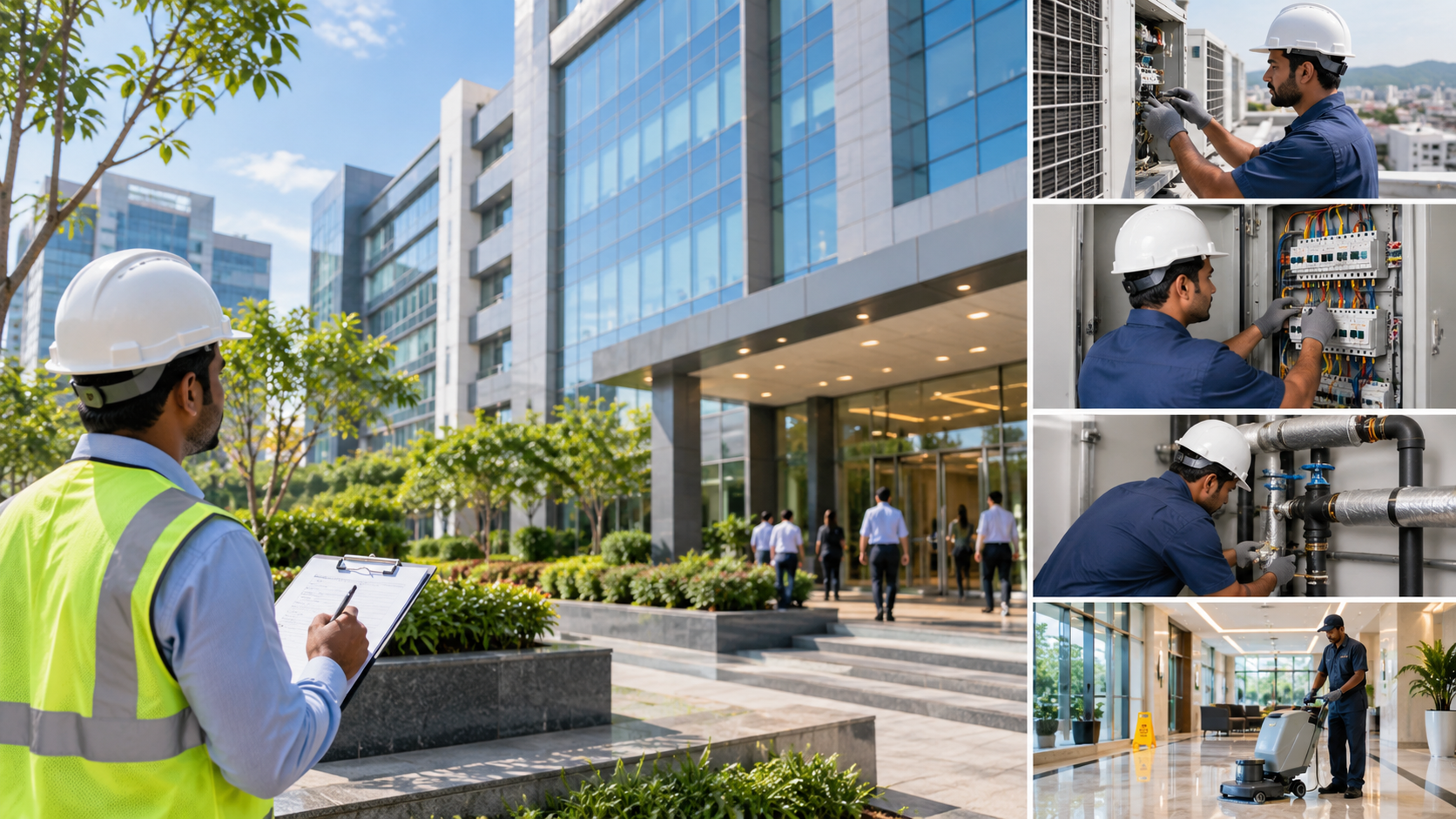
Managing large properties takes a proactive approach to support long-term success. Using preventive maintenance Pune strategies protects assets from demanding operations and seasonal changes across Pune and Pimpri-Chinchwad (PCMC).
A clear building maintenance checklist gives facility managers a useful framework. It protects occupants, costly equipment, and business operations throughout the year.
Commercial properties in Pune and Pimpri-Chinchwad face special challenges, especially during the heavy monsoon season. Regular inspections reduce risks and help maintain high property value.
Our guide covers key areas, including structural integrity and life-safety systems. Strong commercial building maintenance helps prevent costly emergency repairs and extends infrastructure life.
Key Takeaways
- Proactive care is critical for operational stability in local commercial properties.
- A standardized checklist helps organize complex facility management tasks efficiently.
- Seasonal inspections are vital to protect buildings from monsoon-related damage.
- Regular system checks significantly improve the safety and comfort of all occupants.
- Consistent oversight preserves property value and reduces long-term capital expenditure.
How to Build a preventive maintenance Pune Schedule
A strong maintenance schedule supports successful property management in Pune and Pimpri-Chinchwad (PCMC). It keeps assets working and lowers long-term operating costs. With preventive maintenance Pune strategies, you can prevent sudden breakdowns, extend building system life, and maintain efficient facility operations.Assign Maintenance Responsibilities Across the Property Team
Define the roles of facility managers, technicians, security staff, and vendors
Clear ownership supports effective commercial property maintenance Pune. Each team member must know their duties, so no task is missed. Accountability closes service gaps and helps teams solve issues quickly.- Facility Managers: Oversee the entire schedule and coordinate with external vendors.
- Technicians: Perform hands-on repairs and routine equipment checks.
- Security Staff: Monitor common areas and report immediate safety hazards.
- Vendors: Provide specialized facility maintenance services for complex systems like elevators or HVAC.
Maintain service logs, asset registers, warranties, and escalation contacts
Good records support a reliable maintenance program. Keep one central register for every asset, with purchase dates and warranty periods. Detailed service logs track repairs and help you plan future replacements.Organize Tasks by Daily, Weekly, Monthly, and Annual Frequency
Separate routine inspections from scheduled servicing and statutory testing
Efficiency improves when you group tasks by type and urgency. Schedule routine inspections daily to catch minor issues. Complete statutory tests by legal deadlines to support immediate needs and long-term compliance.Use digital work orders, inspection forms, and closure records
Modern facility maintenance services use digital tools to track progress. Mobile work orders let technicians update statuses in real time. These tools create clear completion records for audits and performance reviews.Adapt the Schedule to Pune’s Local Conditions
Account for monsoon rain, humidity, heat, dust, and air pollution
Pune’s climate creates special challenges for commercial property maintenance Pune. Monsoon humidity requires extra waterproofing and mold prevention. Heavy dust and heat also require frequent air-filter and cooling-unit cleaning for strong performance.Prioritize buildings near high-traffic roads, industrial areas, and construction zones
Buildings near busy roads or construction sites face more particulate matter. They need a more active preventive maintenance Pune schedule to protect outside fixtures and ventilation systems. Match maintenance frequency to exposure to keep buildings in top condition.Inspect the Building Structure, Exterior, and Common Areas
A systematic building inspection helps property managers find damage early. Prioritizing commercial building maintenance protects your investment from harsh regional weather. Regular checks stop minor issues from becoming costly structural failures.Check the Roof, Terrace, and Waterproofing Systems
Inspect cracks, ponding water, failed sealants, loose tiles, and membrane damage
Your roof is the building’s main shield against harsh weather. Conduct a detailed exterior building inspection to find cracks, failed sealants, or loose tiles that may cause leaks. Repair membrane damage early to stop water from entering the structure.Clear terrace drains, rainwater outlets, scuppers, and overflow paths before monsoon season
Pune’s heavy monsoon rains require clear drainage paths to prevent ponding water. Clear terrace drains, rainwater outlets, scuppers, and overflow pipes of debris. Proactive cleaning before the rainy season supports effective commercial property maintenance Pune.Examine the Façade, Windows, and External Fixtures
Look for concrete spalling, corrosion, loose cladding, damaged glazing, and unsafe signage
Building façades need regular checks to stay safe and attractive. Look for concrete spalling or corrosion on metal fixtures. Confirm that cladding panels are secure and glazing is intact to protect pedestrians below.Test window seals, façade access equipment, shading devices, and external lighting
Working window seals support energy efficiency and weatherproofing. Test façade access equipment often to keep maintenance crews safe. Also confirm that external lighting works to improve security at night.Maintain Parking Areas, Walkways, and Shared Facilities
Repair potholes, uneven surfaces, damaged ramps, handrails, and accessibility features
Parking areas and walkways receive heavy traffic and need frequent care. Repair potholes and uneven surfaces to prevent accidents and improve user experience. Ensure handrails and accessibility ramps meet safety standards for every visitor.Inspect basement walls, vehicle barriers, drainage channels, and parking ventilation
Basements can develop dampness and poor air quality without proper care. Check basement walls for moisture and confirm that vehicle barriers are sturdy. Maintain drainage channels and ventilation systems as part of commercial building maintenance.Keep Entrances and Interior Common Areas Safe
Check doors, locks, ceilings, flooring, staircases, corridors, and emergency exits
Interior common areas reflect your commercial property maintenance Pune efforts. Check that all doors and locks work smoothly. Inspect ceilings and floors for wear or water damage that could create risks.Remove trip hazards and maintain clear, well-lit paths for occupants and visitors
Safety in corridors and staircases is essential. Remove trip hazards at once and keep emergency exits clear. Maintain well-lit paths to protect everyone entering or using your facility.Service HVAC, Electrical, Plumbing, and Water Systems
A strong building maintenance checklist must protect HVAC, electrical, and water systems for reliable, long-term operations. Proper commercial building maintenance prevents costly downtime and keeps your facility running smoothly throughout the year. These core utilities can also extend the life of expensive equipment.Maintain Air-Conditioning and Ventilation Equipment
Clean filters, coils, drain pans, grilles, diffusers, and fresh-air intake points
Regular cleaning of air-handling units supports efficient HVAC maintenance. Dust on coils and filters restricts airflow, so motors work harder and use more energy.Check refrigerant performance, fan belts, motors, thermostats, vibration, and condensate drainage
Technicians should inspect fan belts for proper tension and check motors for unusual vibrations. Monitoring refrigerant levels helps the system cool well without straining the compressor.Measure indoor temperature, humidity, airflow, and air quality in occupied spaces
Good indoor air quality supports occupant comfort. Regular monitoring can reveal stagnant air or humidity spikes that may cause mold growth.Inspect Electrical Distribution and Backup Power
Test panels, breakers, busbars, cable terminations, earthing, and electrical rooms
Routine electrical maintenance checks that connections are tight and free from corrosion. Testing breakers and earthing systems reduces fire hazards and improves building safety.Use thermal scanning to identify overheated connections and overloaded circuits
Thermal imaging can reveal hidden electrical faults. Teams can fix these hotspots before they cause a total power failure.Service diesel generators, automatic transfer switches, batteries, fuel systems, and UPS units
Backup power systems must engage quickly during a grid outage. Regular generator and UPS testing keeps critical operations powered without interruption.Check Plumbing, Drainage, and Sanitary Fixtures
Inspect pumps, valves, tanks, pipe joints, pressure levels, and concealed leaks
Proactive pump and valve inspections prevent water waste and structural damage. Finding concealed leaks early can save significant repair costs over time.Clean floor traps, sewer lines, grease traps, stormwater drains, and sewage treatment equipment
Clear drainage lines support hygiene and prevent blockages. Regular cleaning of grease traps and sewage treatment plants helps ensure compliance with local environmental standards.Test washroom fixtures, water heaters, flush systems, and sensor-operated fittings
Working washroom fixtures support a positive tenant experience. Testing sensors and flush systems saves water and keeps facilities fully operational.Manage Water Quality and Conservation Measures
Schedule tank cleaning and water quality testing at appropriate intervals
Effective water system maintenance includes periodic storage tank cleaning to prevent contamination. Regular testing ensures the water supply meets safety standards for all occupants.Monitor consumption, leakage, rainwater harvesting systems, and wastewater reuse equipment
Tracking water use helps identify leaks and supports conservation. Maintaining rainwater harvesting and wastewater reuse systems shows a commitment to sustainable building management.| System Component | Inspection Frequency | Primary Goal |
|---|---|---|
| HVAC Filters | Monthly | Air Quality |
| Electrical Panels | Quarterly | Fire Safety |
| Water Tanks | Bi-Annually | Hygiene |
| Diesel Generators | Monthly | Reliability |
Test Fire, Life-Safety, Security, and Vertical Transportation Systems
Protecting a commercial property in Pune requires constant attention to life-safety and security infrastructure. Professional facility maintenance services help keep these complex networks operational at all times. By prioritizing life safety systems, property managers create a secure setting for occupants and visitors.Inspect Fire Detection and Suppression Equipment
A strong fire safety maintenance program provides the first defense against potential hazards. Regular inspections ensure every fire protection component can activate at once.Test smoke detectors, heat detectors, manual call points, fire alarm panels, and annunciators
Technicians must test every detection device during routine checks. Consistency is key when verifying that alarm panels and annunciators communicate correctly during a simulated emergency.Check extinguishers, hydrants, hose reels, sprinkler heads, fire pumps, and fire-water tanks
Suppression equipment needs regular pressure tests and visual inspections. Confirm that fire pumps work and water tanks hold the required emergency capacity.Keep fire doors, escape routes, stairwells, emergency lighting, and exit signage unobstructed
- Clear all debris from stairwells and emergency exits.
- Verify that fire doors close and latch automatically.
- Test emergency lighting to ensure visibility during power failures.
Verify Emergency Preparedness and Evacuation Procedures
Technical systems work only when people know how to respond. Regular training helps occupants move safely through the building during a crisis.Review evacuation maps, assembly points, emergency contacts, and visitor procedures
Display clear evacuation maps on every floor. Keep visitor logs updated, and make emergency contact lists available to security personnel.Conduct documented fire drills and record corrective actions for occupants and staff
Schedule biannual fire drills to test response times. Document each drill and fix gaps found in the evacuation process.Maintain Access Control and Security Systems
Effective commercial building security depends on hardware and software working together. Audit these systems regularly to prevent unauthorized access and monitor building activity.Test CCTV cameras, recording storage, access readers, intercoms, alarms, and barriers
Check that cameras provide clear footage and recording storage works. Test access readers and intercoms to ensure they admit only authorized personnel.Inspect security lighting, guard posts, panic buttons, and emergency communication systems
Keep all exterior areas well lit to deter intruders. Test panic buttons and communication lines to confirm direct connections with the security control room.Service Elevators and Escalators
Reliable vertical transportation supports the daily flow of a busy commercial building. Proper elevator maintenance prevents unexpected downtime and protects passengers.Check doors, alarms, intercoms, leveling, emergency lowering, and ride quality
Technicians should verify smooth door operation and emergency lowering during power outages. Smooth ride quality is a strong sign of a well-maintained system.Coordinate inspections and repairs with licensed elevator service providers
Always partner with licensed elevator service providers for technical repairs. Keep detailed logs to track the life cycle and performance of vertical transport equipment.Prepare Commercial Buildings in Pune for Monsoon and Seasonal Stress
Protecting commercial assets from Pune’s heavy monsoon and summer heat is a critical task. A strong preventive maintenance Pune strategy helps your facility withstand extreme weather. Planning ahead prevents costly emergency repairs and keeps occupants safe.Complete Pre-Monsoon Building Inspections
Preparation supports effective commercial property maintenance Pune. Address weak points before heavy rains arrive to prevent water damage.Clear roof drains, stormwater lines, basement sumps, and external gutters
Debris often causes flooding. Keep every drainage path clear so water flows away from the building.Seal cracks around windows, façades, expansion joints, plumbing penetrations, and terraces
Water often enters through small, hidden gaps. High-quality sealants around these areas stop moisture from entering the building envelope.Test sump pumps, dewatering systems, backup power, and basement flood alarms
These systems provide vital protection during heavy downpours. Test them regularly so they activate as soon as water levels rise.Control Dampness, Mold, and Indoor Air Problems
Rainy-season humidity often causes lasting dampness. Good monsoon building maintenance requires close attention to indoor air quality.Inspect damp walls, ceiling stains, wet carpets, concealed pipework, and HVAC drain pans
Find moisture early. Check hidden areas where water collects, including damp walls, ceiling stains, wet carpets, concealed pipework, and HVAC drain pans. These areas can become breeding grounds for mold.Remove mold safely and correct the moisture source rather than treating surface growth only
Cleaning surfaces alone will not solve a lasting leak. Find and repair the moisture source to prevent mold from returning.Protect Equipment During Heat, Dust, and Power Interruptions
Pune’s climate brings intense heat and dust, which can strain mechanical systems. Regular seasonal building maintenance helps extend the life of critical equipment.Clean outdoor HVAC coils and generator air intakes affected by dust and pollution
Dust buildup lowers cooling and generator efficiency. Regular cleaning prevents overheating and supports strong performance during peak demand.Check surge protection, battery backup, temperature controls, and equipment-room ventilation
Storms can cause power fluctuations. Confirm that surge protection, battery backup, temperature controls, and equipment-room ventilation work properly. These systems protect sensitive electronics.Perform Post-Monsoon Damage Reviews
After the rains end, assess the building’s condition carefully. This review supports long-term preventive maintenance Pune planning.Document water ingress, erosion, corrosion, electrical faults, and structural changes
Record water ingress, erosion, corrosion, electrical faults, and structural changes. Keep a detailed log of your findings. Photos help track issue severity over time.Prioritize repairs according to safety risk, business disruption, and asset criticality
Not every repair needs immediate attention. Address high-risk items first, based on safety risk, business disruption, and asset criticality. This approach helps limit operational impact.| Season | Primary Focus | Key Action |
|---|---|---|
| Pre-Monsoon | Waterproofing | Clear all drainage lines |
| Monsoon | Moisture Control | Monitor for mold growth |
| Summer | Cooling Efficiency | Clean HVAC condenser coils |
| Post-Monsoon | Structural Integrity | Repair erosion and corrosion |
Manage Compliance, Vendors, Documentation, and Maintenance Costs
Commercial property work requires a careful balance between legal rules and affordable operations. Strong commercial property maintenance Pune depends on organized maintenance compliance and decisions based on data.Maintain Required Inspection and Compliance Records
Keep certificates, test reports, permits, service contracts, and statutory inspection dates current
Organized records support successful building operations. Keep permits, service contracts, and inspection schedules in one digital repository to help avoid legal penalties.Track fire safety, electrical safety, lift servicing, water systems, and occupational safety requirements
Regular audits help your building meet local safety rules. Tracking these areas protects occupants and the property’s long-term value.Screen and Coordinate Facility Maintenance Services
Verify technician qualifications, insurance, safety practices, and experience with commercial properties
Effective vendor management starts with careful screening. Choose partners with strong facility maintenance services experience and enough liability insurance.Define response times, preventive tasks, spare-parts standards, reporting requirements, and escalation procedures
Clear service level agreements reduce operational gaps. Set response times, preventive tasks, spare-parts standards, reports, and escalation steps to align teams and contractors.Use Risk-Based Prioritization for Repairs
Classify defects as critical, urgent, planned, or cosmetic
Not every repair needs immediate action, but safety issues must come first. Task categories help your team use resources well without overlooking serious hazards.Address life-safety hazards, active leaks, electrical overheating, and structural risks first
Addressing these risks first helps prevent catastrophic failures. Use the following table to guide your prioritization strategy:| Category | Priority Level | Action Required |
|---|---|---|
| Life-Safety | Immediate | Emergency response |
| Structural/Leaks | High | Within 24 hours |
| Cosmetic | Low | Scheduled maintenance |
Track Performance and Lifecycle Costs
Monitor equipment downtime, repeat failures, energy consumption, water use, and maintenance completion rates
Data analytics show how well your building systems perform. Regular monitoring reveals trends that may signal system upgrades or process improvements.Budget for replacement of aging pumps, chillers, generators, lighting, controls, and safety equipment
Proactive maintenance cost management plans for replacing major assets. Saving money for aging infrastructure helps prevent sudden, costly equipment failures.Turn the Building Maintenance Checklist into a Working Annual Plan
Managing a commercial property in Pune takes more than a list; it requires a structured annual maintenance plan. Organize your building maintenance checklist on a clear timeline to prevent missed tasks. This approach supports professional commercial building maintenance.Use a Practical Inspection Calendar
Schedule daily rounds for visible safety issues and operational abnormalities
Daily inspections help your team find minor issues before they worsen. Check common areas, lighting, and immediate safety hazards to support safe operations.Plan weekly and monthly inspections for equipment rooms, utilities, common areas, and safety systems
Use these intervals to check mechanical rooms and utility performance. A consistent preventive maintenance schedule helps identify early wear on essential building systems.Reserve quarterly and annual periods for specialist testing, major servicing, and compliance reviews
Specialist technicians should conduct deep inspections of fire safety and structural integrity. These reviews help maintain compliance with local regulations and safety standards.Record Findings and Close Corrective Actions
Capture the location, defect, risk level, photograph, assigned person, and due date
Effective corrective action tracking requires detailed records. Record each defect’s location and severity to prioritize repairs efficiently.Verify completed work through follow-up inspections and updated maintenance records
Do not mark a task complete until someone verifies it. A follow-up inspection confirms repair quality and updates your digital logs.Coordinate Maintenance Without Disrupting Occupants
Notify tenants about shutdowns, noisy work, restricted access, and fire or lift testing
Clear communication supports good tenant relations. Give advance notice about activities that may affect daily business operations.Schedule disruptive activities during low-occupancy periods and provide safe alternate routes
Schedule heavy maintenance on weekends or late evenings to reduce noise. Keep clear, safe routes open while work continues.Review the Plan After Major Events or Building Changes
Update asset registers after renovations, tenant fit-outs, equipment replacements, or system upgrades
Your maintenance plan must change with your building. After installing equipment or changing a space, update records with its maintenance needs.Revise inspection frequencies after flooding, fire incidents, repeated breakdowns, or operational changes
Unexpected events can reveal weaknesses in your strategy. Adjust inspection cycles to help your facility withstand future challenges.Conclusion
Effective property management depends on a proactive approach to building health. A structured preventive maintenance Pune strategy protects your investment from the region’s unique environmental challenges.
Regular inspections keep mechanical, electrical, and structural systems in peak condition. A complete building maintenance checklist supports this success by helping teams track performance, manage vendors, and control long-term costs.
Prioritizing safety and compliance lowers the risk of unexpected failures. Regular reviews of your commercial building maintenance plan help your facility withstand seasonal shifts and daily wear. For properties in Pune and Pimpri-Chinchwad (PCMC), adapting maintenance schedules to local weather and building requirements can support a safe and efficient environment.
Refine your maintenance routines today to protect your property’s longevity. Consistent attention to detail creates a reliable, high-performing workspace.
About NAICON FMS
NAICON FMS provides professional facility management and building maintenance solutions for commercial and corporate properties in Pune and Pimpri-Chinchwad (PCMC). Its facility management approach focuses on maintaining building systems, supporting safety and operational efficiency, and helping businesses manage their properties through structured maintenance services.
FAQ
Q1: Why is preventive maintenance important for commercial buildings in Pune?
A: Preventive maintenance helps commercial properties in Pune and Pimpri-Chinchwad (PCMC) identify potential issues before they become costly failures. Regular inspections of HVAC, electrical, plumbing, fire-safety, and structural systems help maintain a safe and efficient workplace.
Q2: What should a building maintenance checklist include?
A: A complete building maintenance checklist should cover HVAC systems, electrical panels, plumbing, elevators, fire-safety equipment, drainage, roofs, façades, and common areas. For properties in Pune and Pimpri-Chinchwad (PCMC), pre-monsoon and post-monsoon inspections should also be included.
Q3: How does commercial building maintenance help during the Pune monsoon?
A: Regular commercial building maintenance helps properties in Pune and Pimpri-Chinchwad (PCMC) prepare for heavy rainfall. Teams can inspect roof drains, waterproofing, basement pumps, façades, and drainage systems to identify and address potential water-related problems.
Q4: What are the benefits of professional facility maintenance services in Pune?
A: Professional facility maintenance services provide trained teams to manage essential building systems and routine inspections. For commercial properties across Pune and Pimpri-Chinchwad (PCMC), structured maintenance can help improve operational efficiency, support safety, and reduce unexpected repair requirements.
Q5: How can NAICON FMS help with commercial property maintenance?
A: NAICON FMS provides facility management and maintenance solutions for commercial and corporate properties in Pune and Pimpri-Chinchwad (PCMC). Its services can support routine inspections, building upkeep, equipment maintenance, and day-to-day facility operations.
