
In the competitive hospitality industry, maintaining a well-managed facility is crucial for guest satisfaction and operational excellence. Delivering facility management solutions for hotels and hospitals pune plays a vital role in ensuring smooth operations. Efficient facilities management becomes the backbone of hotels and healthcare institutions, creating a clean, safe, and welcoming environment for guests, patients, and staff.
The hospitality sector in Pune faces unique challenges, from maintaining infrastructure to adopting sustainable practices. Effective facility management solutions can significantly impact the bottom line of these service-oriented organizations.
This comprehensive guide explores the critical aspects of facilities management specifically designed for hotels and hospitals in Pune, addressing the unique challenges they face.
Key Takeaways
- Efficient facilities management is crucial for guest satisfaction and operational excellence.
- Effective facility management solutions can significantly impact the bottom line.
- Pune’s hospitality sector faces unique challenges, including infrastructure maintenance.
- Sustainable practices are essential for long-term success.
- Comprehensive facility management solutions can address the unique challenges faced by hotels and hospitals.
The Critical Role of Facility Management in Hospitality and Healthcare
As the hospitality industry continues to expand, effective facility management becomes increasingly crucial. The industry is expected to reach $7239.02 billion by 2029, growing at a Compound Annual Growth Rate (CAGR) of 6.1 percent. Thus, it is vital for hotel management to offer the best facilities to attract and retain guests.
Coordinating hospitality services, from housekeeping to maintenance, demands seamless integration to ensure guest experiences are uninterrupted and of high quality. This is a complex task, especially in large hotels or resorts with diverse amenities.
Unique Challenges Faced by Hotels and Hospitals in Pune
Hotels and hospitals in Pune face distinct challenges that require specialized facility management approaches. These include seasonal climate variations, high guest and patient expectations, and intense local competition.
- Balancing luxury expectations with operational efficiency is crucial for hotels.
- Hospitals need to maintain sterile environments while providing comfort.
Impact of Effective Facility Management on Guest and Patient Experience
Effective facility management directly impacts the guest experience in hotels and patient outcomes in hospitals. For hotels, this means well-maintained amenities and responsive service. For hospitals, it involves infection control and creating healing environments.
| Facility Management Aspect | Impact on Hotels | Impact on Hospitals |
|---|---|---|
| Maintenance and Repair | Ensures amenities are in good condition | Ensures equipment reliability |
| Service Quality | Enhances guest experience through responsive service | Improves patient satisfaction through attentive care |
| Environment Control | Provides comfortable environments | Maintains sterile environments for patient safety |
Essential Facility Management Solutions for Hotels and Hospitals
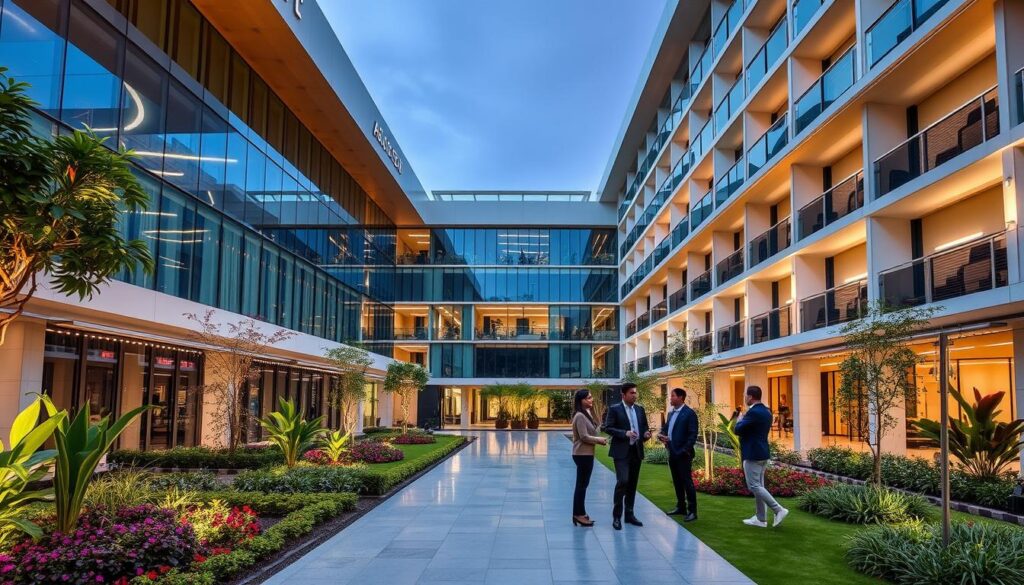
To deliver exceptional guest experiences, hotels and hospitals in Pune must invest in essential facility management solutions. These solutions encompass various aspects, including infrastructure management, security and safety systems, and maintenance and repair services, all of which are critical to operational success.
Core Infrastructure Management Requirements
Core infrastructure management for hotels and hospitals in Pune involves addressing HVAC systems optimized for local climate conditions, electrical systems with backup generators, and water management systems. These elements are crucial for maintaining a comfortable and safe environment.
Security and Safety Systems
Security systems have evolved to include biometric access controls, data protection measures, and integrated emergency response systems. These measures protect both physical assets and sensitive information, building trust among guests and patients.
Maintenance and Repair Services
Preventive maintenance programs are essential for reducing operational disruptions. Modern facility management solutions incorporate mobile-responsive maintenance request systems, improving response times and tracking resolution metrics. This proactive approach can lead to significant cost savings and enhanced operational efficiency.
Technology-Driven Facility Management Approaches
The integration of technology in facility management has revolutionized the way hotels and hospitals operate in Pune. By leveraging advanced technologies, these establishments can significantly enhance their operational efficiency and overall productivity.
IoT and AI in Modern Facility Management
The use of Internet of Things (IoT) and Artificial Intelligence (AI) is transforming facilities management in Pune. IoT sensors track energy usage and equipment performance, while AI analyzes operational information to predict maintenance needs and optimize resource allocation.
Mobile Applications for Real-Time Monitoring and Response
Mobile applications have become essential tools for facility managers, enabling them to monitor systems remotely, receive instant alerts about potential issues, and coordinate maintenance tasks efficiently. This leads to a quicker response to guest requests and maintenance issues, improving overall management.
Some key benefits of technology-driven facility management include:
- IoT sensors providing real-time data on equipment performance and occupancy patterns.
- AI-powered systems analyzing operational data to predict maintenance needs.
- Mobile applications for remote monitoring and efficient task coordination.
- Real-time monitoring systems providing critical metrics for data-driven decisions.
- Technology integration reducing response times for guest requests and maintenance issues.
Sustainable Practices in Facility Management
Pune’s hotels and hospitals are increasingly adopting sustainable facility management practices to reduce their environmental footprint and enhance operational efficiency. This shift is driven by the growing expectations of environmentally-conscious guests and patients.
Sustainable facility management practices have become a competitive advantage, with establishments being selected based on their environmental commitments. Key strategies include energy efficiency solutions and effective waste management programs.
Energy Efficiency Solutions for Hospitality Properties
Energy efficiency is crucial for reducing operational costs and environmental impact. Solutions include smart building management systems, renewable energy installations, and thermal insulation upgrades, which can reduce energy consumption by up to 30%.
Waste Management and Environmental Compliance
Effective waste management involves segregation, composting of organic waste, and partnerships with local recycling facilities. This not only minimizes environmental footprint but also reduces disposal costs. Pune’s environmental compliance requirements are becoming increasingly stringent, necessitating continuous monitoring and adherence to regulations.
| Sustainable Practice | Benefits | Implementation Examples |
|---|---|---|
| Energy Efficiency | Reduced energy consumption, lower operational costs | Smart building management systems, renewable energy installations |
| Waste Management | Minimized environmental footprint, reduced disposal costs | Segregation, composting, recycling partnerships |
Selecting the Right Facility Management Partner in Pune
To deliver exceptional guest experiences, hotels and hospitals in Pune must partner with a facility management company that aligns with their strategic priorities.

When selecting a facility management partner, organizations should consider several key factors to ensure they find a provider that meets their unique needs.
Key Qualifications and Certifications to Look For
Organizations should prioritize providers with specific experience in the hospitality or healthcare sectors. Key certifications to look for include ISO 9001 for quality management, ISO 14001 for environmental management, and OHSAS 18001 for occupational health and safety.
Evaluating Service Level Agreements and Performance Metrics
Service Level Agreements (SLAs) should clearly define performance metrics related to response times, resolution rates, and guest satisfaction scores. The best facility management partners offer customizable service packages that can scale with seasonal demand fluctuations or adapt to the 24/7 operational requirements of hospitals.
Evaluating a potential partner’s technology infrastructure is crucial, as advanced Computerized Maintenance Management Systems (CMMS) provide transparency and accountability that drive continuous improvement in facility operations.
Cost Considerations for Implementing Facility Management Solutions
When it comes to facility management, understanding the cost implications is crucial for businesses. Implementing facility management solutions requires a thorough analysis of various cost factors to ensure that the chosen strategy aligns with the organization’s financial capabilities and operational needs.
Facility management costs can significantly impact the bottom line of hotels and hospitals in Pune. Proper maintenance practices not only extend the lifespan of equipment but also reduce energy consumption and waste generation, promoting a more sustainable operation. This can be a selling point for environmentally conscious guests, potentially increasing occupancy rates.
Budget Planning for Different Property Sizes
Budget planning for facility management varies significantly based on property size. For instance, Pune’s luxury hotels typically allocate 4-6% of their revenue to facility management. In contrast, hospitals often budget based on square footage and specialized equipment requirements. It’s essential to consider these factors when planning the budget for facility management services.
| Property Type | Budget Allocation Basis | Typical Allocation Percentage |
|---|---|---|
| Luxury Hotels | Revenue Percentage | 4-6% |
| Hospitals | Square Footage and Equipment | Varies |
ROI Analysis and Long-Term Value Assessment
Conducting an ROI analysis is crucial when evaluating facility management investments. This involves considering both direct cost savings, such as reduced energy consumption and lower emergency repair costs, and indirect benefits like improved guest satisfaction and enhanced reputation. A comprehensive ROI analysis helps businesses understand the long-term value of their facility management investments.
Key factors to consider in ROI analysis include: extended equipment lifespan, improved operational efficiency, and enhanced guest experience. By outsourcing facility management services, businesses can also benefit from predictable operating expenses, although this may come with potentially higher overall costs compared to well-managed internal teams.
Staff Training and Integration with Facility Management Systems
The success of facility management systems in hospitality and healthcare depends heavily on well-trained staff. A well-trained team is at the heart of exceptional guest service, and providing continuous training and skill development programs ensures that staff members can meet evolving industry demands and guest expectations.
Developing Competent Facility Management Teams
Developing competent facility management teams requires a combination of technical training on specific systems and soft skills development for guest/patient interaction. Cross-training staff across multiple facility systems creates operational resilience, allowing teams to respond effectively during staff shortages or emergency situations.
- Technical training on facility management software and hardware
- Soft skills development for enhanced guest interaction
- Cross-training for operational resilience
Fostering Collaboration Between Departments
Fostering collaboration between departments can be achieved through integrated work order systems, shared performance metrics, and regular cross-departmental meetings. This ensures that facility management priorities are aligned with overall organizational goals, improving overall service efficiency.
- Integrated work order systems for streamlined operations
- Shared performance metrics for transparency
- Regular cross-departmental meetings for alignment
Case Studies: Successful Facility Management Implementation in Pune
In Pune, hotels and hospitals have achieved remarkable results by adopting comprehensive facility management strategies that prioritize guest experiences and safety. Effective facility management has become a cornerstone for enhancing operational efficiency and reputation in these industries.
Hotel Success Story: Operational Efficiency Improvements
A luxury hotel in Pune implemented an integrated facility management system, achieving significant improvements in operational efficiency. The system reduced energy consumption by 22% and decreased maintenance response times from 45 to 12 minutes. As a result, guest satisfaction scores improved by 18% within the first year. The hotel’s strategic approach to preventive maintenance minimized guest disruptions, virtually eliminating negative reviews related to facility issues.
Hospital Success Story: Enhanced Safety and Patient Satisfaction
A leading hospital in Pune transformed its facility management approach by implementing IoT-enabled equipment monitoring. This resulted in 99.8% uptime for critical systems, improved infection control metrics, and enhanced staff productivity. The integrated security and safety systems not only protected patients and staff but also streamlined compliance reporting, reducing administrative burden while improving regulatory outcomes.
Conclusion: Future-Proofing Your Facility Management Strategy
To stay ahead in the competitive hospitality industry, it’s essential to future-proof your facility management strategy. This involves embracing emerging technologies like predictive analytics and automation that anticipate needs rather than simply responding to them.
As guest expectations continue to evolve, hotels and hospitals in Pune must adopt best practices in facilities management to deliver exceptional experience. This includes implementing climate resilience measures, contactless services, and personalized environmental controls.
By viewing facility management as a strategic function rather than a cost center, organizations can gain a competitive advantage through environments that adapt to changing needs and support operational excellence. Our knowledgeable sales consultants are available worldwide to answer any questions and help you enhance your hospitality services.
About Naicon FMS :
At Naicon FMS (Facility Management Services), we specialize in providing comprehensive facility management solutions for hotels and hospitals across Pune, Pimpri-Chinchwad (PCMC), and throughout India, ensuring impeccable cleanliness, operational efficiency, and a safe, hygienic environment for guests and patients alike. With our headquarters in Pune (MIDC) and a strong presence in major industrial hubs, we deliver tailored services including housekeeping, sanitation, eco-friendly cleaning, pest control, security, maintenance, and compliance support that meet industry standards and regulatory requirements. Our expert team proudly serves entities in key Maharashtra industrial regions such as MIDC Bhosari, MIDC Pimpri Chinchwad(PCMC), MIDC Chakan, MIDC Talegaon, MIDC Ranjangaon, MIDC Satara, MIDC Nagpur, MIDC CChhatrapati Sambhajinagar, MIDC Lote, MIDC Mumbai, MIDC Navi Mumbai and MIDC Badlapur, helping hospitality and healthcare facilities maintain a clean, safe, and welcoming environment. With a focus on quality, sustainability, and customer satisfaction, Naicon FMS is your trusted partner for managing facility operations in hotels and hospitals across urban and industrial landscapes.
